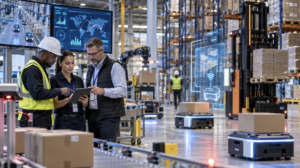
The modern warehouse is undergoing one of the most significant transformations in its history. What was once a labor-intensive environment filled with forklifts, pallet racks, conveyors, and manual inventory processes is becoming a highly connected operation powered by information technology (IT), artificial intelligence, robotics, and intelligent automation. Companies are discovering that warehouse performance no longer depends exclusively on how quickly employees can move products. It increasingly depends on how efficiently technology can coordinate people, equipment, inventory, and information.
This transformation is changing the role of material handling equipment across manufacturing facilities, distribution centers, logistics operations, and fulfillment warehouses. Traditional equipment remains essential, but businesses are finding new opportunities to combine established handling systems with digital technology. From predictive maintenance and automated inventory tracking to intelligent forklifts and cloud-based warehouse management, IT is helping companies improve accuracy, reduce operational interruptions, and respond to changing customer expectations.
As these technologies become more accessible, the future of warehousing will depend on a practical balance between reliable equipment, informed employees, and connected digital systems. Understanding how these elements work together has become an important consideration for businesses preparing to modernize their operations.
How Information Technology Is Changing Traditional Warehouse Operations
For decades, warehouse productivity depended heavily on physical infrastructure and equipment selection. Forklifts transported pallets, conveyors moved products between workstations, and shelving systems provided organized storage. While these solutions remain fundamental, the information surrounding their operation was often recorded manually or managed through separate software applications.
Information technology is changing that relationship by connecting warehouse activities through centralized systems. Modern warehouse management software can record inventory movements, assign storage locations, coordinate picking operations, and provide supervisors with a more accurate picture of daily activity.
When products arrive at a distribution center, barcode scanning or radio-frequency identification technology can register their entry into inventory. Warehouse software can then determine where products should be stored according to available space, demand patterns, and operational requirements.
Instead of relying entirely on employee experience to select storage locations or determine picking sequences, organizations can use software-generated instructions to make these processes more consistent.
The result is an environment where physical equipment and digital information support one another. Material handling machinery performs the work of moving and storing goods, while IT systems help determine when, where, and how that work should happen.
This integration is particularly valuable for facilities managing thousands of products, fluctuating order volumes, and increasingly demanding delivery schedules.
Artificial Intelligence Is Bringing New Capabilities to Warehouse Automation
Artificial intelligence is becoming an important technology for warehouse operations because it can analyze large amounts of information and identify patterns that traditional software may overlook.
Warehouse managers routinely make decisions involving inventory placement, equipment availability, staffing, order priorities, and transportation schedules. These decisions become more difficult when operating conditions change throughout the day.
AI-powered systems can evaluate historical order data, current inventory levels, and operational activity to support more effective planning. For example, software may identify products that are frequently purchased together and recommend positioning them closer to packing stations.
Machine learning can also help automated equipment navigate busy warehouse environments.
In March 2026, MIT News reported on an AI system designed to improve warehouse robot traffic. Developed by researchers from MIT and Symbotic, the approach uses reinforcement learning to help determine which robots should receive priority when congestion develops.
The research illustrates a practical challenge facing increasingly automated facilities. Adding more robots does not automatically produce greater efficiency. Without effective coordination, equipment can compete for limited aisle space, creating delays that reduce the benefits of automation.
Artificial intelligence offers a way to address these problems by allowing software to adapt to changing conditions rather than depending exclusively on fixed movement instructions.
However, successful implementation still requires accurate data, reliable communication networks, appropriately configured equipment, and employees who understand how to operate the technology.
The Internet of Things Is Making Material Handling Equipment Smarter
The Internet of Things, commonly called IoT, allows physical equipment to collect and exchange information through connected sensors, communication networks, and software platforms.
Within warehouse operations, IoT technology can provide insight into equipment utilization, battery performance, operating conditions, maintenance requirements, and other activities that influence productivity.
A connected forklift, for example, may generate information about operating hours, battery status, travel activity, and detected impacts. Authorized supervisors can use this information to identify potential problems and evaluate how equipment is being used throughout the facility.
Conveyor systems equipped with sensors can detect operating irregularities, while connected storage equipment can help monitor product movement or system status.
The value of these capabilities extends beyond collecting information. Data becomes useful when organizations can convert it into decisions that improve operations.
A warehouse experiencing repeated equipment downtime might analyze operating records to identify maintenance patterns. Another facility might discover that certain forklifts are heavily utilized while others remain idle for extended periods.
These insights can support better scheduling, more balanced equipment usage, and informed purchasing decisions.
The National Institute of Standards and Technology (NIST) has examined the relationship between connected industrial systems, operational reliability, and cybersecurity. Its work highlights how increased connectivity creates new capabilities while also introducing security considerations that organizations must address.
For warehouse operators, this means connected equipment should be evaluated not only for its technological features but also for its reliability, compatibility, and security.
Why Material Handling Equipment Suppliers Remain Essential in an Automated Industry
Despite growing investment in robotics and warehouse software, physical material handling equipment continues to provide the foundation for daily operations.
Pallet jacks, forklifts, lift tables, industrial carts, conveyors, and storage systems serve practical functions that digital technology cannot replace. Even highly automated facilities depend on dependable equipment to receive goods, move inventory, organize storage, and prepare shipments.
This creates an important consideration for companies planning warehouse upgrades. Technology investments should complement the equipment required to perform physical work.
Working with an experienced Material Handling Equipment Supplier can help businesses evaluate equipment options based on load requirements, facility layout, operating conditions, and handling needs.
For some organizations, modernization may involve integrating new software with existing equipment. Others may need to upgrade handling machinery, redesign storage areas, or introduce automation gradually.
A small distribution facility, for example, may achieve meaningful productivity improvements through better inventory software, improved storage organization, and reliable handling equipment without investing in an expensive robotic installation.
Larger operations may benefit from automated storage systems, advanced conveyors, and connected industrial vehicles.
The most effective approach depends on the actual requirements of the business rather than the newest technology available.
Warehouse modernization succeeds when digital systems and physical equipment are selected as parts of the same operational strategy.
Robotics and Automated Storage Systems Are Reshaping Distribution Centers
Warehouse robotics has progressed beyond traditional automated conveyors and fixed machinery. Modern facilities can incorporate autonomous mobile robots, automated guided vehicles, robotic picking systems, and computerized storage solutions.
These technologies are designed to reduce repetitive travel, support product movement, and improve the consistency of certain warehouse processes.
Autonomous mobile robots can transport inventory between designated locations while using sensors and navigation software to respond to their surroundings. Automated guided vehicles generally operate along predefined paths or guidance systems, depending on their design.
Another important development involves automated storage and retrieval systems, commonly known as AS/RS.
As described in Wikipedia’s overview of automated storage and retrieval systems, these systems use computerized controls to store and retrieve materials from designated storage locations. The technology has existed for decades, but advances in software, sensors, and equipment design have expanded its applications.
In facilities with limited floor space, automated storage systems can help businesses make better use of available vertical storage capacity.
Robotic systems may also reduce the amount of walking required for workers involved in picking and packing. Instead of employees repeatedly traveling across large warehouse areas, automated equipment can bring designated products or containers closer to workstations.
The benefits, however, are influenced by product characteristics, throughput requirements, facility layout, and system maintenance.
Not every product can be handled effectively by the same robotic solution. Irregular packaging, unusually heavy loads, fragile materials, and changing inventory requirements may demand specialized equipment or human involvement.
For this reason, many warehouses are adopting a hybrid operating model in which automation handles suitable repetitive tasks while employees manage exceptions, inspections, maintenance, and activities requiring judgment.
Cloud Computing Is Connecting Warehouse Operations Across Multiple Locations
Warehouse operations increasingly extend beyond a single building. Manufacturers, distributors, retailers, and logistics providers often manage inventory across multiple facilities, transportation networks, and sales channels.
Cloud computing allows authorized users to access shared operational information without depending entirely on locally hosted software.
A cloud-based warehouse management system can help businesses coordinate inventory records, monitor fulfillment activity, and exchange information with enterprise resource planning systems.
For example, when an order is processed through an online sales platform, integrated software can communicate with warehouse systems to identify available inventory and initiate fulfillment activities.
As products move through receiving, picking, packing, and shipping, the associated records can be updated across connected business applications.
This coordination can reduce duplicate data entry and improve visibility between departments.
It also creates opportunities for more informed decisions involving inventory replenishment, labor planning, and warehouse capacity.
Cloud adoption does introduce practical responsibilities. Organizations must evaluate network reliability, vendor security, system integration, access controls, and data recovery procedures.
For businesses operating multiple distribution centers, however, the ability to share consistent information across facilities can be an important advantage.
Digital Twins Are Helping Businesses Plan More Efficient Warehouses
One of the more promising developments in industrial technology is the digital twin.
A digital twin is a virtual representation of a physical asset, process, or environment that can use operational data to reflect real-world conditions.
Rather than making facility changes based exclusively on assumptions, warehouse managers can use simulation and modeling tools to evaluate potential improvements before implementing them.
According to IBM’s explanation of digital twin technology, digital twins can support monitoring, simulation, performance analysis, and operational planning by connecting digital models with information from physical systems.
In a warehouse environment, a digital twin could represent equipment locations, storage configurations, product movements, and material flow.
A company considering a new conveyor installation might use simulation software to examine how the equipment would influence traffic through the facility.
Another operation might model alternative storage layouts to determine whether frequently ordered products could be positioned more efficiently.
Digital twins may also help organizations test different operating conditions, such as increased order volume or changes in equipment availability.
These capabilities do not eliminate the need for physical inspections, engineering evaluations, or operational experience. The quality of the simulation depends on accurate information and realistic assumptions.
Nevertheless, digital modeling gives businesses another way to evaluate significant investments before committing resources to equipment purchases or facility modifications.
RFID and Real-Time Inventory Tracking Are Improving Warehouse Visibility
Accurate inventory information is essential for effective warehouse operations.
Even a well-organized facility can experience significant problems when inventory records do not match actual product quantities or locations.
Radio-frequency identification, or RFID, offers an alternative or complement to conventional barcode scanning by using radio signals to identify tagged items.
Depending on the technology and operating environment, RFID readers can capture information without requiring the same direct line of sight generally needed for barcode scanning.
The technology can support receiving, inventory verification, product identification, and movement tracking.
The global standards organization GS1 provides technical standards for RFID, including identification formats and communication specifications intended to support consistent data exchange across supply chains.
For businesses handling large quantities of merchandise, these standards are particularly important because products often move between different suppliers, transportation providers, warehouses, and retail operations.
Effective inventory tracking requires systems that can exchange information accurately across those environments.
RFID technology can help reduce certain manual scanning requirements, but successful implementation depends on tag selection, reader placement, software integration, and environmental conditions.
Metal surfaces, liquids, product packaging, and facility configurations can affect reading performance.
Organizations considering RFID should therefore evaluate the technology against their specific inventory characteristics and operational requirements.
When implemented appropriately, connected identification systems can provide better visibility into where inventory is located and how it moves through the warehouse.
Predictive Maintenance Is Changing How Equipment Is Serviced
Equipment downtime can disrupt an entire warehouse operation.
A malfunctioning forklift may delay loading activities, while a conveyor failure can interrupt the movement of products between departments.
Traditional maintenance approaches generally involve scheduled inspections, servicing based on equipment usage, or repairs after a problem occurs.
Predictive maintenance adds another option by using operational data to help identify potential equipment problems before they cause failures.
Sensors can collect information related to vibration, temperature, motor performance, and other measurable operating conditions.
Analytics software may then compare current measurements with historical performance to identify unusual patterns.
For instance, a conveyor motor displaying increasingly abnormal vibration could be flagged for inspection before a complete failure occurs.
This approach can help maintenance teams prioritize work according to equipment condition rather than relying exclusively on fixed service intervals.
However, predictive maintenance is not a substitute for manufacturer-recommended inspections or established safety procedures.
Businesses must also consider whether the cost of sensors, software, training, and system integration is justified by the equipment’s importance and maintenance history.
For facilities where interruptions create substantial operational consequences, condition-monitoring technology may offer meaningful value.
Cybersecurity Is Becoming a Critical Part of Warehouse Technology
As warehouses become more connected, cybersecurity is moving beyond traditional office computers and business networks.
Modern facilities may depend on network-connected equipment, wireless scanners, industrial controllers, remote monitoring systems, and cloud applications.
These connections can improve operational visibility, but they also create potential points of exposure.
An unauthorized intrusion affecting warehouse management software could interrupt order processing. Compromised industrial systems could create more serious operational or safety concerns, depending on the equipment involved.
The Cybersecurity and Infrastructure Security Agency (CISA) provides recommended practices for protecting industrial control systems, including guidance addressing network security, access management, incident response, and operational technology vulnerabilities.
Warehouse operators adopting connected technology should consider security throughout the purchasing and implementation process.
Practical safeguards may include separating operational technology networks from general business systems, controlling remote access, maintaining appropriate backups, applying tested security updates, and restricting equipment administration to authorized personnel.
Employee training is also important because cybersecurity incidents can originate through compromised credentials, phishing attempts, and unsafe access practices.
Security planning should extend to equipment vendors, software providers, and outside maintenance contractors when those organizations require access to connected systems.
A smart warehouse cannot depend entirely on efficient equipment and sophisticated software. Its underlying technology must also remain reliable and appropriately protected.
How IT Is Influencing Warehouse Safety and Employee Productivity
Technology is also influencing how warehouse employees interact with equipment and their surrounding environment.
Connected industrial vehicles may incorporate impact detection, operator authorization systems, or monitoring tools that help supervisors identify unsafe operating patterns.
Warehouse management software can improve task organization by providing more consistent instructions and reducing unnecessary movement.
Automation can limit certain repetitive handling activities, particularly where employees would otherwise transport materials across long distances or perform physically demanding tasks repeatedly.
However, technological improvements do not automatically eliminate workplace hazards.
Autonomous vehicles introduce new traffic considerations, while robotic equipment requires carefully designed interaction zones, maintenance procedures, and emergency controls.
Businesses must evaluate equipment safety according to applicable regulations, manufacturer instructions, and the conditions of their facilities.
Warehouse employees also need appropriate training when digital systems alter established workflows.
A worker familiar with a manually operated process may require additional instruction when that process becomes connected to automated software or robotic equipment.
Successful modernization therefore involves more than installing technology. It requires clear procedures, employee participation, and continuous evaluation of how equipment and people work together.
The Future of Smart Warehouses Will Depend on Integration, Not Automation Alone
The next phase of warehouse development is likely to involve greater coordination between the technologies already entering industrial facilities.
Artificial intelligence may help optimize the movement of autonomous equipment. IoT sensors can provide information about operating conditions. Digital twins may support facility planning, while cloud systems connect warehouses with purchasing, transportation, and customer service operations.
The underlying objective is to create an operation where decisions can be informed by more accurate and timely information.
At the same time, businesses will need to avoid treating automation as an objective in itself.
A warehouse with expensive robotics but poorly organized inventory may still struggle with efficiency. Likewise, advanced analytics cannot compensate for unsuitable equipment, inadequate maintenance, or unreliable operational data.
Companies preparing for smart warehouse investments should begin by identifying measurable operational challenges.
These may include excessive product handling, frequent equipment interruptions, inaccurate inventory records, inefficient storage arrangements, or delays in order fulfillment.
Once those challenges are understood, decision-makers can determine which combination of equipment improvements and technology investments offers the most practical path forward.
Smaller businesses may begin with barcode-based inventory management, improved handling equipment, and basic software integration.
Larger organizations may pursue robotic fulfillment, automated storage, predictive maintenance, and complex warehouse orchestration platforms.
Neither approach is inherently superior. The appropriate investment depends on operational requirements, available resources, and long-term business objectives.
Ultimately, the defining characteristic of a smart warehouse will not be the number of robots operating inside it. It will be the ability of people, equipment, and information systems to work together effectively.
Conclusion: IT Is Redefining the Future of Material Handling and Warehouse Efficiency
Information technology is changing material handling from a primarily equipment-driven function into an increasingly connected and data-informed operation.
Artificial intelligence is helping coordinate warehouse activity, robotics is changing how products move through facilities, and IoT technology is providing greater visibility into equipment performance. Cloud computing, digital twins, and advanced inventory systems are giving businesses new ways to plan operations and respond to changing demand.
Yet the physical requirements of warehousing remain unchanged. Products still need to be received, lifted, transported, stored, picked, and shipped. Reliable material handling equipment remains central to accomplishing those tasks safely and efficiently.
The greatest opportunities lie in combining established equipment solutions with technology that addresses genuine operational needs.
Organizations that approach modernization with clear objectives, appropriate equipment, employee training, and responsible cybersecurity practices will be better positioned to take advantage of advances in warehouse technology.
The future of smart warehousing is not simply about replacing traditional operations with machines. It is about using information technology to make the entire material handling process more connected, responsive, and productive.