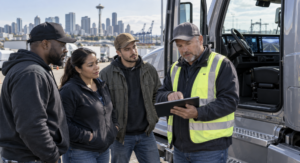
🚛 Technology has transformed nearly every major industry in Washington State, and commercial trucking is experiencing some of the most significant changes in its history. From artificial intelligence and advanced navigation systems to electronic safety monitoring and electric commercial vehicles, modern transportation is becoming increasingly sophisticated. These developments are changing how freight moves through the Pacific Northwest and what professional drivers need to know before entering the workforce.
For Washington businesses, the connection between information technology and transportation is particularly important. Seattle’s economy depends on a complex network of shipping terminals, warehouses, distribution centers, manufacturers, and transportation companies. Behind that network are skilled commercial drivers responsible for moving essential goods throughout the region and across the country.
As the trucking industry adopts new technology, professional driver education is becoming even more valuable. Training programs such as EmeraldSky CDL School help future commercial drivers develop the practical knowledge, safety awareness, and operational skills needed to begin careers in an increasingly technology-driven industry.
Washington IT News: Why Technology Is Transforming the Trucking Industry
The commercial trucking industry has traditionally depended on mechanical expertise, driving experience, and detailed knowledge of transportation regulations. Those skills remain essential, but modern trucks are now equipped with sophisticated electronic systems that help drivers and fleet operators manage daily operations.
Many commercial fleets use GPS navigation, electronic logging devices, vehicle diagnostics, digital dispatch platforms, and transportation management software. These technologies allow trucking companies to monitor vehicle performance, coordinate shipments, improve scheduling, and maintain regulatory compliance.
The development of intelligent transportation systems demonstrates how information technology is becoming integrated into transportation infrastructure. These systems combine communication networks, traffic monitoring, electronic data, and automated technologies to improve mobility and roadway safety.
For Washington’s technology sector, trucking represents an important example of digital transformation happening outside traditional offices and software companies. The same advances in connectivity, data analytics, and automation that support modern businesses are also helping transportation companies manage thousands of miles of daily freight movement.
Professional truck drivers increasingly work in an environment where understanding electronic equipment is part of performing the job effectively.
How Seattle Truck Driving School Fits Into the Future of Commercial Transportation
Preparing for a trucking career involves considerably more than learning to steer a large vehicle. Commercial drivers must understand vehicle inspections, safe operating procedures, traffic regulations, cargo considerations, and the responsibilities associated with transporting freight.
EmeraldSky CDL School provides professional commercial driver education for individuals interested in entering this industry. Its Seattle Truck Driving School program combines classroom learning with practical driving instruction, helping students build a foundation for obtaining a commercial driver’s license.
The school emphasizes essential driving skills, including vehicle inspections, backing maneuvers, defensive driving, highway operations, and Department of Transportation regulations. Its published program information also addresses electronic logging devices, GPS-based fleet management, and modern vehicle technologies.
These fundamentals are increasingly relevant as trucking companies introduce advanced equipment into everyday operations. A driver who understands vehicle systems, safety requirements, and professional operating procedures is better positioned to adapt to new technology throughout a transportation career.
The relationship between driver education and technological progress is straightforward. Modern equipment can provide valuable information and assistance, but professional drivers remain responsible for interpreting conditions, operating safely, and making appropriate decisions on the road.
Electronic Logging Devices Are Changing Daily Trucking Operations
One of the most significant technological developments in commercial trucking has been the widespread adoption of electronic logging devices, commonly called ELDs.
These devices electronically record driving activity and help commercial drivers and motor carriers maintain hours-of-service records. They have largely replaced traditional paper logs for drivers subject to federal ELD requirements.
The Federal Motor Carrier Safety Administration’s electronic logging device training resources explain how these systems support compliance with driving-hour regulations intended to reduce fatigue-related safety risks.
Electronic recordkeeping introduces responsibilities that extend beyond operating a truck. Drivers must understand how to use logging systems correctly, identify duty-status information, and maintain accurate records.
Digital documentation also helps transportation companies organize operational information more efficiently. Dispatchers and fleet managers can use appropriate electronic records to monitor compliance and coordinate transportation activities.
For future truck drivers entering the workforce, familiarity with electronic recordkeeping and federal safety requirements is an important part of professional preparation.
Artificial Intelligence and Smart Technology Are Reshaping Freight Transportation
Artificial intelligence is introducing new possibilities for commercial transportation. Freight companies can use data-driven systems to study traffic patterns, estimate arrival times, improve maintenance scheduling, and identify more efficient transportation routes.
Predictive maintenance is one particularly useful application. Modern commercial vehicles can collect diagnostic information about engine performance and other mechanical systems. Analytical software can help maintenance teams identify developing problems before those problems result in expensive breakdowns.
Route optimization technology offers another advantage. By evaluating traffic congestion, distance, delivery requirements, and operational restrictions, routing platforms can help transportation companies develop more efficient schedules.
Advanced driver-assistance systems are also becoming more prominent in commercial vehicles. Depending on the truck and its equipment, these systems may provide collision warnings, lane-departure alerts, adaptive cruise control, and emergency braking assistance.
Although these technologies can support safer operations, they do not eliminate the need for professional driving judgment. Commercial drivers must continue to monitor roadway conditions, maintain appropriate following distances, recognize hazards, and respond to unexpected situations.
🚦 The future of trucking will depend on a combination of capable drivers and increasingly intelligent transportation equipment.
Washington’s Freight Industry Depends on Modern Infrastructure
Washington occupies an important position in domestic and international freight transportation. Its ports, highways, rail connections, and distribution networks support the movement of agricultural products, manufactured goods, construction materials, and consumer merchandise.
The Seattle metropolitan area serves as a major transportation gateway, connecting maritime shipping activity with regional distribution centers and highways reaching other parts of Washington and neighboring states.
The Washington State Department of Transportation’s Freight System Plan examines the movement of goods across highways, railways, waterways, and aviation networks. The plan highlights the importance of maintaining an efficient, safe, and reliable freight system to support Washington’s economy.
Digital technologies have become valuable tools in managing this infrastructure. Traffic information systems, freight scheduling software, transportation data, and electronic communication help logistics companies plan around congestion and changing conditions.
The relationship between trucking and technology is particularly visible around busy freight corridors. Commercial drivers operating near Seattle and Tacoma regularly encounter urban traffic, industrial facilities, shipping terminals, and complex highway networks.
These conditions require careful attention, sound judgment, and an understanding of professional commercial vehicle operation.
As Washington continues improving its transportation infrastructure, skilled drivers will remain essential to connecting physical freight operations with the technology used to manage them.
Commercial Driver Training Is Becoming More Important as Industry Standards Evolve
Commercial truck driving is a regulated profession with specific licensing, training, and safety requirements.
Federal entry-level driver training standards establish baseline requirements for certain individuals seeking their first Class A or Class B commercial driver’s license, upgrading from Class B to Class A, or obtaining specified endorsements.
According to the Federal Motor Carrier Safety Administration’s Entry-Level Driver Training regulations, applicable training requirements include theory instruction and, for relevant CDL classes, behind-the-wheel training completed through registered training providers.
These requirements reflect the serious responsibilities involved in operating commercial vehicles.
Professional driver education helps students develop practical skills while becoming familiar with the regulations governing commercial transportation. Training typically addresses inspections, vehicle control, backing, road operations, safety procedures, and applicable transportation laws.
For new drivers, learning these fundamentals provides a foundation that remains relevant even as trucks and transportation systems evolve.
A career in commercial driving involves continuing education as well. Drivers may need to learn unfamiliar vehicle technologies, new company procedures, updated regulatory requirements, and equipment-specific operating practices throughout their careers.
That willingness to continue learning is becoming an increasingly valuable professional trait.
Electric Trucks and Sustainable Transportation Are Creating New Opportunities
⚡ Vehicle electrification is another development attracting attention throughout the transportation industry.
Electric commercial trucks are being introduced in applications where vehicle range, charging infrastructure, payload requirements, and operating schedules make electrification practical. Regional deliveries, port-related transportation, and some urban freight operations are among the applications being explored.
Electric trucks operate differently from conventional diesel-powered vehicles. Drivers and fleet operators must account for charging availability, battery range, energy consumption, vehicle weight, and maintenance considerations.
These differences introduce new training and operational requirements for transportation companies adopting electric equipment.
Electric trucks also create opportunities for cooperation among technology developers, electrical infrastructure providers, vehicle manufacturers, transportation companies, and workforce training organizations.
In Washington, where technology and transportation are important parts of the regional economy, these developments illustrate how industries are becoming more closely connected.
Diesel trucks will continue serving many freight applications while electric and other alternative-powertrain technologies develop. Drivers entering the industry today may encounter several types of commercial vehicle technology during their working lives.
Understanding the basic principles of safe vehicle operation provides an essential starting point regardless of how a commercial truck is powered.
Truck Driving Careers Remain Important in an Increasingly Automated Economy
As artificial intelligence and automation become more capable, conversations about the future of employment frequently focus on jobs that technology could change.
Commercial trucking presents a more complicated picture. Although automation may alter certain driving tasks, professional drivers also perform inspections, monitor equipment, manage changing road conditions, communicate with dispatchers, and handle responsibilities associated with freight delivery.
The U.S. Bureau of Labor Statistics’ Occupational Outlook Handbook projects employment of heavy and tractor-trailer truck drivers to grow 4 percent from 2025 through 2035. The agency estimates approximately 214,500 job openings annually, on average, during that period, including openings associated with workers leaving the occupation.
The Bureau also reports a median annual wage of $58,640 for heavy and tractor-trailer truck drivers in May 2025. Actual earnings vary by experience, location, employer, freight specialization, and type of driving assignment.
Commercial driving can offer several career directions. Some drivers prefer local delivery routes that allow them to return home regularly. Others pursue regional freight transportation or long-distance trucking that takes them across multiple states.
Additional opportunities exist in specialized transportation, including refrigerated freight, flatbed operations, construction equipment hauling, and certain tanker applications requiring additional qualifications.
These different career paths make professional CDL training relevant to individuals with a wide range of employment goals.
Seattle’s Road Conditions Provide a Valuable Learning Environment
Seattle presents driving conditions that require careful attention from commercial vehicle operators.
Drivers must navigate busy interstate corridors, urban intersections, changing weather, steep grades, and industrial areas where large trucks routinely operate near smaller vehicles and pedestrians.
The Pacific Northwest’s wet weather introduces additional considerations involving braking distances, visibility, traction, and defensive driving techniques.
For new commercial drivers, learning to recognize and respond to these conditions is an important part of developing confidence behind the wheel.
Practical training provides opportunities to build vehicle-control skills while receiving instruction and feedback from experienced trainers. Repeated practice helps students become more familiar with the space required for turns, backing maneuvers, lane changes, and safe stopping.
Driver education in the Seattle area also introduces students to the broader transportation environment in which they may eventually work.
Professional preparation is especially important because commercial vehicles require greater stopping distances, wider turning areas, and more deliberate maneuvering than passenger cars.
Technology may help drivers monitor certain hazards, but effective vehicle control and situational awareness remain central to roadway safety.
Washington CDL Requirements Connect Training With Career Readiness
Individuals pursuing commercial driving careers in Washington must understand the state’s licensing process.
The Washington State Department of Licensing provides information about commercial learner permits, licensing requirements, testing, and eligibility.
Washington generally allows qualified individuals age 18 or older to pursue a commercial driver’s license, while interstate commercial driving ordinarily requires drivers to be at least 21 years old.
Applicants must satisfy applicable licensing requirements, which can include knowledge testing, required training, a commercial learner permit, skills testing, and medical qualifications.
Training programs help individuals prepare for the practical responsibilities and assessments associated with commercial driving.
Beyond licensing, employers may have additional requirements related to experience, safety records, equipment qualifications, and the types of freight being transported.
For those planning a career change, understanding these expectations before entering the industry can help create a more realistic path toward employment.
Why Truck Driver Education Belongs in Washington IT News
The growth of transportation technology creates a compelling connection between Washington’s information technology industry and its commercial driving workforce.
Software platforms and advanced equipment can help a trucking company coordinate deliveries, monitor vehicles, and process information. However, physical goods still require transportation between ports, warehouses, businesses, and consumers.
This creates a continuing relationship between digital innovation and hands-on professional skills.
A modern supply chain involves far more than an online order or automated warehouse system. Its successful operation depends on communication networks, transportation infrastructure, reliable equipment, and trained professionals capable of moving freight safely.
Organizations such as EmeraldSky CDL School contribute to this workforce by helping prospective drivers prepare for commercial licensing and professional transportation responsibilities.
As businesses adopt artificial intelligence, connected vehicle systems, digital dispatching, and alternative-powertrain trucks, driver training provides an important starting point for those entering the industry.
For Washington’s technology community, trucking offers a clear example of how innovation affects established professions while creating new demands for education, adaptability, and practical knowledge.
Conclusion: The Future of Washington Trucking Combines Technology With Skilled Drivers
🚛 Washington’s transportation industry is entering a period in which technology will play an increasingly influential role in how commercial freight is managed and delivered. Artificial intelligence, electronic logging systems, smart vehicle technology, digital fleet management, and electric trucks are changing daily operations across the industry.
These advances offer opportunities for greater efficiency, improved operational visibility, and stronger safety practices. At the same time, commercial transportation continues to depend on trained professionals who understand vehicle operation, roadway conditions, regulatory responsibilities, and the demands of moving freight.
EmeraldSky CDL School represents an important part of that connection between traditional workforce skills and the changing transportation industry. By providing classroom education and hands-on commercial driving instruction, the school helps individuals prepare for careers in a field where practical ability and technological familiarity increasingly work together.
For Washington’s technology sector, the broader lesson extends beyond trucking. The future of innovation depends on people who can apply new technology effectively in the real world.
As transportation systems become more sophisticated, skilled commercial drivers will continue playing a vital role in supporting Seattle’s economy, Washington’s freight infrastructure, and the nationwide supply chains that connect businesses and communities.
The next chapter of trucking will be shaped by intelligent technology, modern equipment, and the professionals trained to operate it safely.